Loomnote · Notes
Everyday writing and notes.
Your data stays yours.
Capture a thought, then organize it with tags. Keep private writing on your devices and chosen storage, in a format you can take with you.
Web · iPhone / iPad on the App Store, including China mainland · Desktop app in development
Start privacy with a clear answer: who holds the notes?
From writing a note to taking it with you
Everyday editing and offline use
Optionally your own GitHub repo or S3-compatible bucket
Markdown files to export and keep using
A data ownership overview: Loomnote does not host note bodies. Sync still requires trust in the chosen storage service; local caching is not an encrypted vault. Sync capabilities vary by platform and version.
Write first, organize later
A tag tree, reverse-chronological notes and Markdown turn ideas, drafts and daily notes into one writing habit.
Sync is a choice with boundaries
Choosing your storage still means managing access, devices and backups. Local-first does not imply automatic end-to-end encryption of every piece of data.
Capture now. Find it when you need it.
Tags are navigation
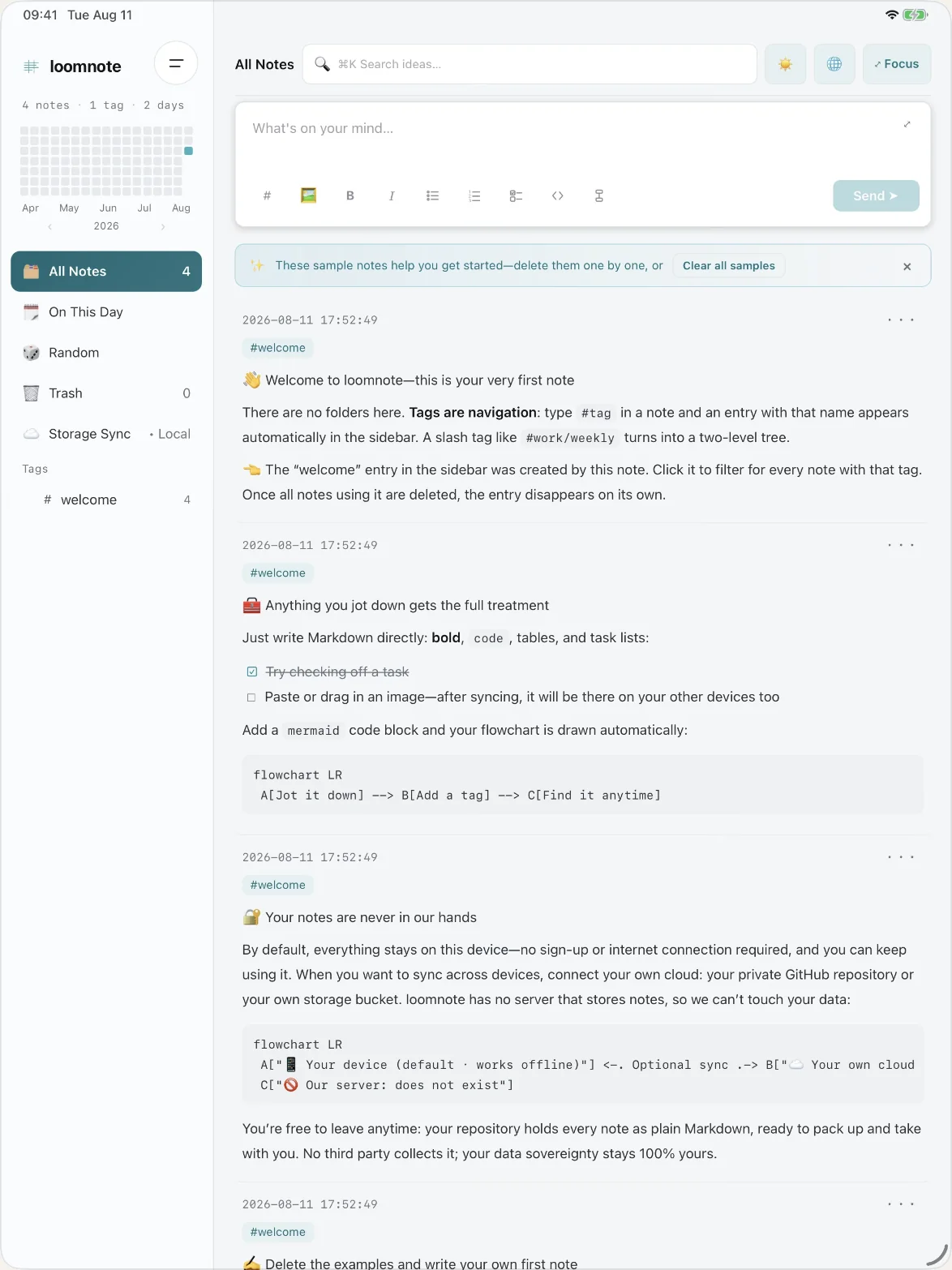
Type #tag to create a sidebar entry; #work/weekly creates a two-level tree. Tags disappear when no notes use them, without planning folders first.
Capture without waiting
Notes appear on Enter while saving finishes in the background; failed saves can be retried or discarded. Each note is a plain Markdown file, rendering code, lists, images and tables as you write.
Diagrams and search
Mermaid code blocks render diagrams. Use ⌘K to search your notes.
Five interface languages
Switch the interface between Simplified Chinese, Traditional Chinese, English, Japanese and Korean.
How your notes are stored and travel
Notes are written locally first and work offline. Optionally sync to your own GitHub repository or S3-compatible bucket. Files remain Markdown: clone the GitHub repository or retrieve files from the bucket. Loomnote does not host a database of note bodies.
In the Web app, note reads and writes go directly from your browser to api.github.com or the configured S3 bucket. The GitHub OAuth token exchange passes through an edge Worker with a no-store response; the application does not persist or actively log the token. We still serve the frontend JavaScript that your browser runs, and local caches hold plaintext. This provides explicit ownership, not a zero-trust system or an automatically end-to-end encrypted vault.
Read your notes with your own AI
A local read-only MCP server provides search_notes, get_note, list_notes and list_tags for clients such as Claude Desktop and Claude Code. Version 1 does not expose create, edit or delete operations to agents. Open AI Connection and copy the client snippet or command with the local path filled in. Note bodies do not need to be uploaded to Loomnote; if your AI client uses a cloud model, selected note content may still be sent to that model service.
Web, iPhone and iPad
Available in the browser and on the App Store for iPhone and iPad, including China mainland. Requires iOS / iPadOS 17 or later. The desktop app remains in development. Storage and sync capabilities depend on the platform and current version.